Do what thou whilt shall be the whole of the law,
“All these old letters of my Book are aright; but צ is not the Star. This also is secret: my prophet shall reveal it to the wise.”—Liber AL vel Legis I:57
This above quote was delivered to The Master Thereon via AIWASS under the guise of Nuit, goddess of the stars during the writing of The Book of the Law. As Nuit, she had particular interest in ensuring such an important symbol was correctly attributed. Crowley himself resolved the situation by referring to Frieda Harris’s “Loop in the Zodiac” concept. However, it is well known that there was an error in her diagram and Crowley had listed two different values for The Star depending on which source you look at.¹
After investigation, I’ve come to the conclusion that Crowley’s solution was wrong. The actual answer is a lot more straightforward. Let’s take a moment and look at what the Zohar has to say on Tzaddi:
“צ then went before him, saying: ‘Because I mark the Zaddikim (the righteous), and thou thyself nearest me in thy name, Zaddik (righteous), and also it is written “The righteous Lord loveth righteousness,”Ps. 9:8 it will become thee to create the world by me.’ Then said the Holy One: “Zaddi, Zaddi, thou art truly righteous, but thou must keep thyself concealed, and thy occult meaning must not be made known or become revealed; and therefore thou must not be used in the creation of the world. Thy original form was a rod, symbol of the female principle, surmounted by Yod, a letter of the holy Name, and also of the Holy Covenant, and emblem of the male principle. (By this, reference is made to the first man, who was androgynous, with faces turning one to the right, the other to the left, as symbolized in the figure of Zaddi in the Hebrew alphabet). But the time will come that thou shall be divided, and thy faces shall then be turned to each other.”
—The Zohar¹
Now let’s consider that meaning for a second; a figure is divided between male and female and then turns together toward each other. Where have we seen that? Why, it’s in The Book of The Law!
“For I am divided for love’s sake, for the chance of union.”—Liber AL vel Legis I:29
In this, she is describing how Nuit, the passive or Yin force , was divided from Hadit, the active or Yang force, for the sake of the union of the two which produces the third (hidden) force Yung, or The Child of the Aeon Ra-Hoor-Khuit. It is the hidden stone of V.I.T.R.I.O.L., or the Magnum Opus; the formula ABRAHADABRA; the union of opposites to create the divine Hermaphrodite.
Remember for a moment that Nuit said the prophet would reveal it, not that he would correctly explain it. Therefore, I believe he got this one wrong. Allow me to explain why.
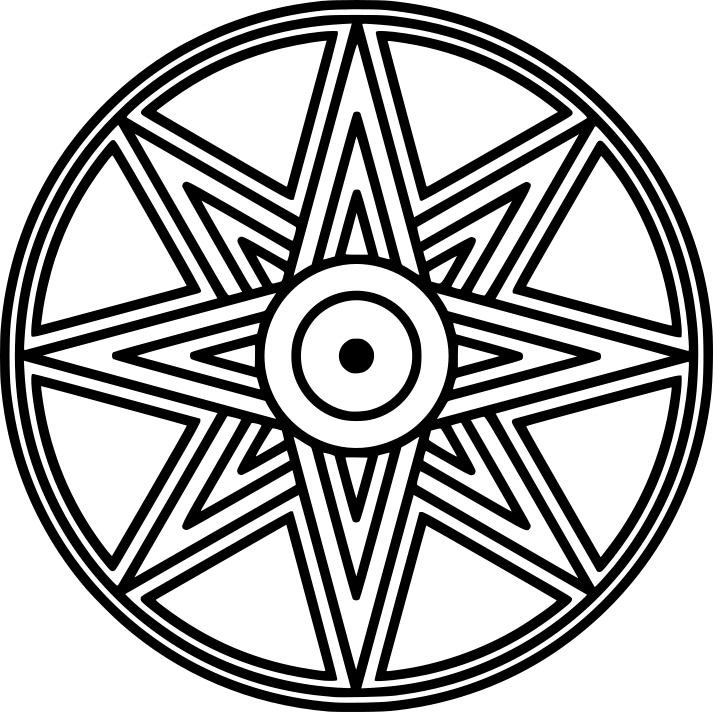
The problem with Crowley relying on modern astrology is it’s more than thrice removed from its original cultural context and has accumulated a lot of extra layers since it was originally devised by the ancient Babylonians. In Babylonian iconography there are only 3 stellar objects that show up consistently and have significant meaning and those 3 happen to be the same 3 that show up in The Tarot; The Sun, The Moon and The Star. Each symbol associates with a particular Babylonian deity. The Sun is Šamaš. The Moon is Sîn. The Star is Ištar and her star in question is what we know today as the planet Venus, the evening and morning star.
By the late Babylonian period, when the Greek astrologers were traveling to Babylon to learn the art, Ištar had been broken up and syncretized with another lesser-known god, Ashtar. The Evening and Morning Star became separated into male and female versions of the same deity. Ištar herself is the goddess of sex, and her priestesses were all trans women (known in Sumerian as galla, often mistranslated as eunuch). Her sukkal (divine attendant) was Ninšubur; a deity who was initially the sukkal of Anu, the sky god, but after the temple Eanna (the house of heaven) was “captured” from Anu by Ištar and became a temple to her, Ninšubur became her sukkal instead. Interestingly when Ninšubur was the sukkal of Anu, he was referred to with masculine pronouns. However, once she became the sukkal of Ištar, she was referred to with feminine pronouns. Given that one of the rituals performed at the Eanna temple was the Head Overturning Rite, a ritual gender transition, and the high priestess Enheduanna described Ištar (under her Sumerian name Inanna) as holding the power to change a man into a woman and a woman into a man; it’s safe to say that Ninšubur transitioned from man to woman under her power.
“But thou art beyond man and woman, my star is in thee, and thou shalt avail.”
—Liber 49:46
Further, Ištar’s most prominent myth is her famous journey into the Underworld; a story which reflects the motif of the shamanic journey and is even described in the formula V.I.T.R.I.O.L.; Visitam Interiorem Terre Rectificatum Invenias Ocultum Lapidum. “Visit the interior of the earth, which through rectifying you will find the hidden stone.” At the climax of her descent, Ištar faces the underworld goddess Ereškigal and is slain for her efforts and hung on the wall on a hook. It is then Ninšubur’s task to enlist the help of the creator god Ea (pronounced “yah”, Sumerian name Enki) to revive her. He sends two genderless beings to bring her the water and food of life. They charm Ereškigal and convince her to give them the corpse of Ištar which they then revive. She reemerges from her ordeal triumphant having obtained the Me (knowledge and magical talisman) of death. Now having been hung and revived, Ištar goes from merely being a goddess of war described as having a garden of human skulls (see the Babylonian Epic of Gilgamesh) to a goddess of wisdom second only to Ea.
“I am Life, and the giver of Life, yet therefore is the knowledge of me the knowledge of death.”—Liber AL vel Legis I:6
In any case, Ištar as the evening and morning star is a figure who looks upon the Earth in one direction in the morning and the opposite direction in the evening; her two sides look upon each other; just like how Tzaddi is described in the Zohar after the time will come. It is now my belief that the time in question is the onset of the New Æon Crowley was the herald of. So, why should Tzaddi be represented by a symbol of division, when it is in fact the value of ultimate union?
So where does it go then? Well, as any good student of the Kabbalah well knows, we already have a Hebrew letter that corresponds to Venus; ז Zain, which was traditionally attributed to The Lovers. The Lovers is a much better card to attribute to this symbolic union of opposites than The Star; a card symbolizing the exact opposite. Therefore, I believe the passage in The Book of the Law, as fully understood should be rather that under the New Æon, Zain and Tzaddi are to swap their places; which is to say Tzaddi is not The Star nor The Emperor as Crowley decided, but rather Tzaddi is The Lovers, and Zain is The Star.
It even works if you think about the word meaning of each respected letter; Tzaddi is Fish Hook, the very thing that the corpse of the slain Ištar was hung from at the moment of her disillusion and a tool used to draw things together. Zain is Sword, a tool which divides things in two; just like the water being poured by the lady on The Star is divided into the river and into the earth.
In the Kabbalah, Zain is not the symbol of harmony and love we might expect if the card was indeed The Lovers, rather it is the symbol of discrimination or discernment. This implies separation; in order to discern one thing is separate from another thing one must focus on the differences; one must divide them into separate boxes. It is separation that drives identification. Define what it is not, and you will soon narrow it down to what it is. If we consider for a moment the alchemical process, this would be the step of distillation. The water is boiled off leaving only the crude matter behind.
“And God said, “Let there be a vault between the waters to separate water from water.” So God made the vault and separated the water under the vault from the water above it. And it was so. God called the vault “sky.” And there was evening, and there was morning—the second day.” —Genesis 1:6-8
So, indeed Tzaddi is not The Star; The Star is Zain, the divider, the sign of Ištar at war, the division of the primal ocean and sky. Tzaddi is The Lovers, the union of opposites, the Hieros Gamos of the soul; the sign of Ištar triumphant.
ABRAHADABRA
Love is the law, love under will.
¹https://nofaithinthehumanrace.com/index.php?changemode=1&show777=1